
Phone-Free Academy: Primary
Priory Witham Academy Mobile Phone Guidance - Primary
Expectations
As children get older and become more independent, we do see an increase in the number of mobile phones that are brought into school. This usually happens when pupils enter Year 5 and Year 6 and are able to walk to and from school without their parents/carers. We would not expect a child in a year group younger than this to bring a mobile phone to school. If your child is in Year 4 and below, and you want them to bring their mobile phone to school, please discuss this with their class teacher in the first instance.
Whilst at school, mobile phones must not be used, seen, or heard during the school day. Mobile phones will be turned off and put away at the green gates before the children enter their playground and remain off until pupils leave their playground at the end of the day. Upon entering a primary classroom, mobile phones will be handed in to an adult and locked away for the day. They will be returned to pupils at the end of the day before they go home.
The academy staff will support all pupils with the best chance of success by:
- Teaching, practising and displaying the Mobile Phone Relentless Routine
- Modelling the rules, behaviour and character we want pupils to develop
- Taking Collective Responsibility for promoting excellent pupil behaviour
- Understanding our pupils and their individual needs
- Supporting the role of the Parent/Carer
- Following an education and wellbeing approach
- Maintaining a Calm, Consistent and Reflective Practice in how they manage behaviour around the academy
Relentless Routine:
Routines are part of our behaviour curriculum and are used to teach and reinforce the expected standards of behaviour. Routines are repeatedly rehearsed, displayed and practiced to promote the values of the academy. The Mobile Phone Routine will support the academy in being a mobile phone free site. Pupils have been made aware of the expectations around mobile phones and the rationale for these. Building good habits and routines takes time, but maintaining these expectations is critical to success. This has been further supported by communication home.

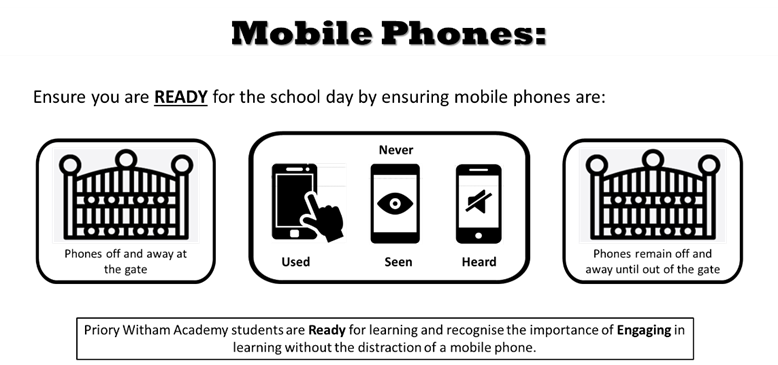
The routine for primary pupils will also include:
- Mobile phone handed in on arrival to your class teacher
- Mobile phone locked away with no access until the end of the day
Modelling Expectations:
A main priority of our behaviour curriculum is for all adults to model expected behaviours in and around the academy site. During the school day, staff will only use their mobile phones in the workroom, staffrooms and office spaces. Duty staff will be vigilant and will consistently reinforce the academy’s expectations, which should deter pupils from attempting to use their mobile phone when arriving and leaving the academy grounds.
Collective Responsibility:
For pupils to be successful, these boundaries need to be clear and consistently applied across the academy and by every member of staff.
Understanding our Pupils:
Some pupils may require their mobile phone for medical purposes. Staff will be made aware of these pupils and reasonable adjustments will be implemented to ensure pupils can be kept safe and well within the academy.
Role of Parents/Carers
Parents are encouraged to:
- Support the school policy
- Monitor and set limits on home phone use
- Promote healthy sleep routines (no phones at night)
Research indicates that overall daily phone use, not just school-time use, has the greatest impact on outcomes.
Consequences:
The vast majority of pupils will follow the expectations regarding mobile phones. There will be a small number however, who do not and we will need to manage this behaviour. As an academy it is important that consequences are applied:
- Calmly: to avoid confrontation
- Consistently: to ensure fairness
- Proportionately: to avoid layering consequences or over punishment
Mobile phones should be turned off and handed in once inside the classroom so they are not Used, Seen or Heard. If they are not handed in, the following consequences will be applied:
|
Misuse in learning spaces or around the academy site during the school day |
|
|
Misuse |
*The confiscation of the mobile phone is the consequence at this stage |
|
Repeat Misuse |
*The confiscation of the mobile phone is the consequence at this stage |
|
Persistent Misuse |
*The confiscation of the mobile phone is the consequence at this stage |
Refusal to follow the process and system outlined above will result in the academy following their normal behaviour policy. This will be escalated accordingly and may result in pupils spending time in, reflection (removed from timetable) or in rare cases receiving a suspension.
Educational and Wellbeing Approach:
In line with research evidence, the school will not rely on restriction alone. We will:
- Teach digital literacy and responsible phone use through PSHE
- Educate pupils about:
- sleep and screen time impacts
- online safety and cyberbullying
- Encourage healthy habits:
- reduced screen time outside school
- increased physical activity
Frequently Asked Questions:
- What if my child wants to contact me? If your child has a valid reason to contact you, they can speak with an adult who will be able to support.
- What if I want to contact my child? If you want to contact your child you can ring the academy and we will be able to support you.
- What about to and from school? We recognise that parents/carers often want their child to have their mobile phone on the way to school and on the way home for safety reasons. The academy has, therefore, not applied a total ban on phones and will allow pupils to have phones in their possession as long as they follow the agreed expectations in place as outlined in this guidance.
- What if my child’s mobile phone has been confiscated and I cannot collect it? Parent/carers can collect confiscated phones from Primary Reception at their earliest convenience and up until 30pm. Any uncollected phones will be returned to the pupil at the end of the next day.
- Do schools have the power to confiscate mobile phones? Yes. Schools have the legal power to confiscate and retain mobile phones if they consider it proportionate. We have clearly outlined what we deem as proportionate in this guidance. Furthermore, the law protects staff from liability to any loss or damage to items they have been confiscated as a sanction, providing they have acted lawfully.