Music
 |
 |
“Music is the universal language of mankind.” — Henry Wadsworth Longfellow
Our Academy has a thriving musical culture, where pupils at all levels learn, create, and perform together. Students regularly take part in high-quality Music and Performing Arts events, showcasing their talents in performances that are well attended and celebrated across the academy community.
We are committed to delivering outstanding music education from the earliest stages. From Year 1 onwards, all pupils receive regular whole-class music lessons taught by experienced and highly skilled music educators. We believe that active participation in music supports academic achievement—particularly in English and Mathematics—as well as enhancing confidence, wellbeing, self-esteem, and social development. We aim for all children to develop a lifelong enjoyment of music and the confidence to express themselves creatively.
Across the academy, pupils develop their skills through singing, listening, composing, and performing. Musicianship is carefully built through a structured curriculum, including the Kodály approach, which is taught as a discrete year-long module in Year 1 and Year 5. Pupils also benefit from whole-class instrumental tuition, delivered by specialist teachers, with a clear progression of instruments across year groups:
-
Years 1–2: Singing and tuned percussion
-
Years 3–4: Recorders and world percussion
-
Years 5–6: Ukulele and keyboard, including the use of musical notation
In addition, pupils have access to small-group instrumental lessons for those wishing to develop their skills further. These are delivered by specialist instrumental tutors at a highly competitive cost. Instruments currently offered include piano, guitar, violin, cello, saxophone, flute, clarinet, trumpet, trombone, and euphonium.
We are also proud of our well-established and popular KS2 Choir, which provides further opportunities for performance and enrichment.
Our pupils follow a bespoke music curriculum that builds on and extends the National Curriculum for Music at Key Stages 1 and 2.
Key Stage 1
In Key Stage 1, pupils develop their musical understanding through singing, chanting, and spoken rhythm work. They learn to use their voices expressively and creatively, and begin to develop musical awareness through the Kodály approach, using singing to internalise key musical concepts. Pupils then apply this learning through tuned and untuned percussion. They listen to a wide range of high-quality live and recorded music, exploring works from great composers through to popular music, and begin to experiment with and combine sounds creatively through engaging topics such as Carnival of the Animals, Robots, and A Pirate’s Life for Me.
Key Stage 2
In Key Stage 2, pupils build on their prior learning to perform confidently in solo and ensemble contexts, using their voices and a range of instruments, including keyboards in Years 5 and 6. They develop increasing accuracy, fluency, control, and expression. Pupils improvise using structured musical activities and explore composition for a variety of purposes, including topics such as Circus, Music Through History, and Famous Musicians. They develop secure understanding of staff notation and other forms of musical notation, alongside a growing aural awareness supported by Kodály and Dalcroze approaches. Pupils also study a wide range of musical traditions, including West African drumming and samba, and explore the work of influential composers and artists such as Saint-Saëns, Mozart, Louis Armstrong, Elvis Presley, and The Beatles.
Curriculum Intent
Our Music curriculum aims to:
- Provide a role in the emotional, cultural, social and academic development of our students.
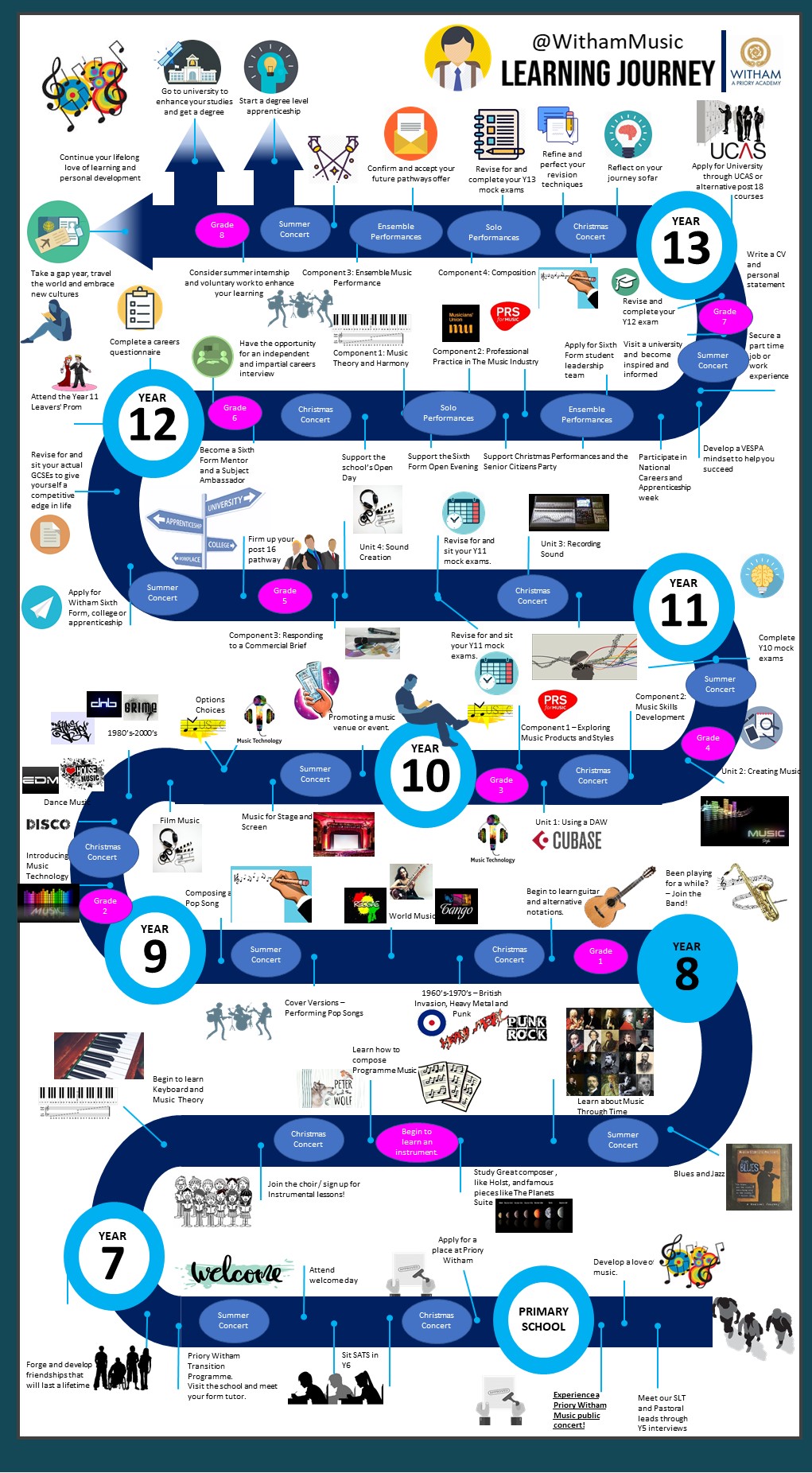
- Develop skilled musicians, from Year 1 through to Year 13, enabling them to achieve to their musical potential.
- Emphasise the intrinsic musical value of well-developed individual musicianship.
- Be rigorous and faithful to the rich inheritance of music education, and is underpinned by our external qualifications.
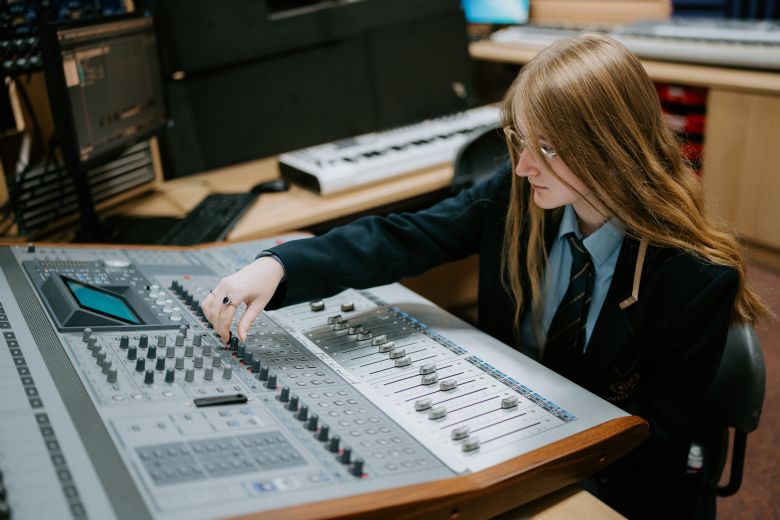
- Provide ample enrichment opportunities (performances, extra-curricular ensembles, recording technology available,) which enables students to reach their aspirations to acquire and apply skills that they value in a practical context.
- Provide practical skills which are progressively built upon and applied in the acquisition of knowledge about specific styles, genres, time periods and location-based music.
- Provide composing, performing and listening assessments, incorporating history, aural, theory and notation.
- Allow students to demonstrate self-reflection skills and critical reflection on the processes used.
We use a range of assessment strategies across the curriculum to accurately identify understanding, address gaps in learning, and ensure all pupils continue to make strong progress.
The Essential Characteristics of a Witham Musician
At The Priory Witham Academy, our ambition for all pupils is for them to master the following characteristics:
- A musical understanding underpinned by high levels of aural perception, internalisation and knowledge of music, including high or rapidly developing levels of technical expertise.
- Very good awareness and appreciation of different musical traditions and genres.
- An excellent understanding of how musical provenance – the historical, social and cultural origins of music – contributes to the diversity of musical styles.
- The ability to give precise written and verbal explanations, using terminology effectively, accurately and appropriately.
- A passion for and commitment to a diverse range of musical activities.
- A continually widening repertoire which they use to create original, imaginative, fluent, accurate and expressive composing and performance work.